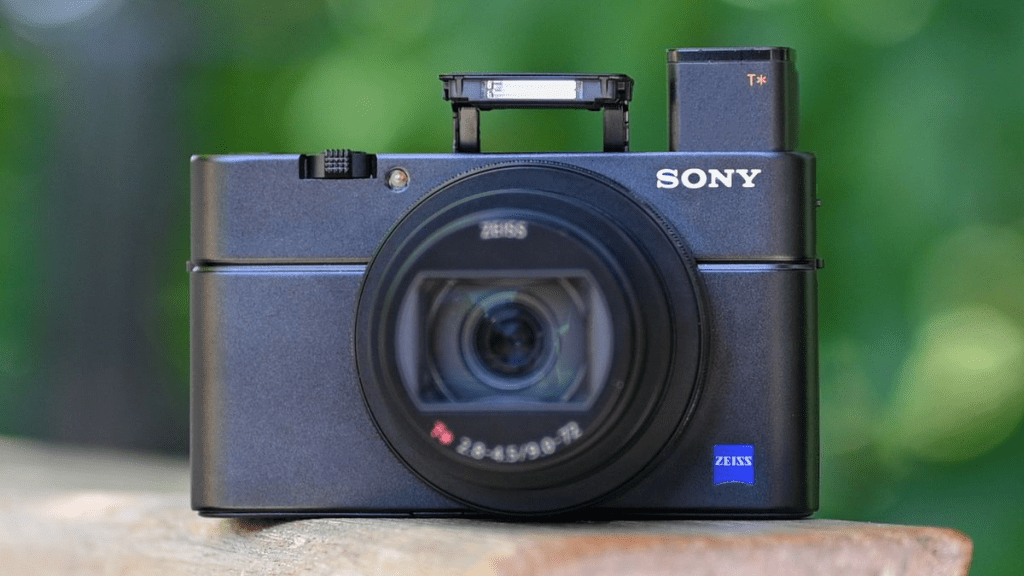
Almost every summer right the way back to 2012, Sony’s had a tradition. Each July, the company best camera for personal use wows us with a brand-new large-sensor, pants pocket-friendly camera in its trendsetting RX100-series. July 2019 didn’t disappoint, as Sony has once again given its flagship RX100-series camera a leveling-up to create the Sony RX100 VII, a camera which the company suggests will offer the speed of its full-frame, flagship A9 mirrorless camera in a much, much more portable form-factor.
Externally identical, right down to the 8x zoom lens
Physically, the seventh-generation, 20-megapixel RX100 VII is nearly identical to its predecessor, offering up exactly the same 24-200mm equivalent, 8x optical zoom lens on its front surface. (The only change we’ve noticed externally is an additional flap for a new port on the right side of the camera body.)
The choice of lens is something of a mixed blessing. Like that of the RX100 VI before it, the RX100 VII’s lens offers far more reach than do the roughly 3-4x zooms of their RX100-series forebears, which really frees you up to frame distant subjects more tightly without having to get up close yourself. But its f/2.8-4.5 lens also has a full stop less-bright maximum aperture across the portion of the zoom range shared by both cameras, which will cause you to have to shoot at higher sensitivity or a lower shutter speed than you’d otherwise have needed with earlier models. And in addition, the newer 8x zoom lacks a built-in neutral density filter that, in earlier models, allowed you to slow the shutter speed, something that’s particularly useful for capturing smoother, more lifelike movies under harsh sunlight, and also improves upon your long-exposure options for stills.
Pocket-friendly performance and autofocus are the big stories here
So what’s new? In covering the launch of the previous-generation RX100 VI last summer — and perhaps feeling given to a little gentle hyperbole at the time — we referred to it in our headline as being “an A7 III in your pocket”. Well, with the RX100 VII, Sony is drawing its own comparison to an even higher-end model, and aiming to deliver “the speed of an A9 in your pocket.”
There’s no denying that the RX100M7 is an exceptionally swift camera, and doubly so by pocket camera standards. It’s capable of shooting 20 full-resolution frames each second, and that’s with autofocus and exposure adjustments between frames. “But wait,” we hear you saying, “wasn’t the RX100 VI capable of 24 frames per second with AF/AE?”
More point-dense, faster autofocus and human/animal eye AF
Well, err… yes, that’s true, but it wasn’t capable of offering “real-time tracking” and eye autofocus (both human and animal), as does the Sony A9 and, now, the RX100 VII as well. And if you’re really just after raw speed without being worried about autofocus then the RX100 VII has another ace up its sleeve anyway, which I’ll come back to in a moment.
But first, I want to circle back to autofocus, because honestly I think this is where the big news is for most photographers. Thanks to a newly-developed 1-inch type CMOS image sensor, the RX100 VII now has even more phase-detection autofocus points, with a total of 357 PDAF points covering 68% of the image frame in the new model, up from 315 points (65% coverage) in the RX100 VI. And far more contrast-detection AF points are defined too, with a total of 425 on offer in the RX100 VII, vs. just 25 points in the previous camera.
 Site Title
Leave a comment